Pin assignment of the electrical coupler
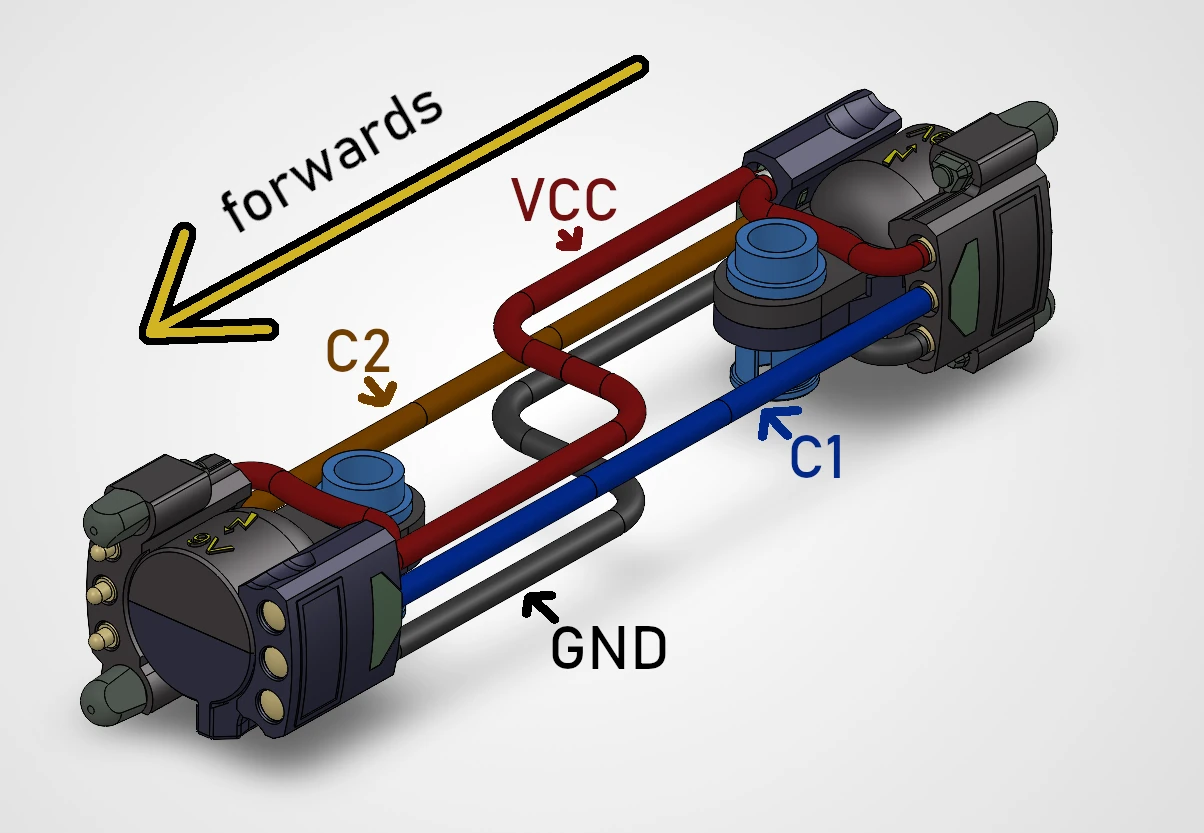
So we have four wires, thus we need four contact pins on the electrical coupler?
No, not that easy.
If we did that, we would not be able to change the direction of travel of the individual vehicles in our train. To make this possible, we must ensure that the same cables are always connected to each other, even when the vehicle is travelling "backwards".
Thus, the pin layout on the coupler has to be symetrical.
The spring loaded pin on the left hand side needs to connect to the same wire, as the fixed pin on the right hand side.
This is exactly, how the VCC and GND wires will be connected to the coupler.
The VCC wires will occupy the upper pair of contacts, while the GND wires will occupy the lower pair of contacts.
This way, they can not be mixed up by changing the direction of individual vehicles in the train.
However, the C1 and C2 wires are different.
In this special case, it actually fits quite well to have them switched around when changing the direction, the individual vehicle is traveling.
Thus, they are not placed symetrical.
Instead, they do not change place on the other end of the vehicle. One wire is on the left hand side of the vehicle, and the other is on the right hand side of the vehicle.
| Channel | Colour | Side | State when traveling forwards | State when traveling backwards |
|---|---|---|---|---|
| C1 | blue | left | GND | VCC |
| C2 | brown | right | VCC | GND |
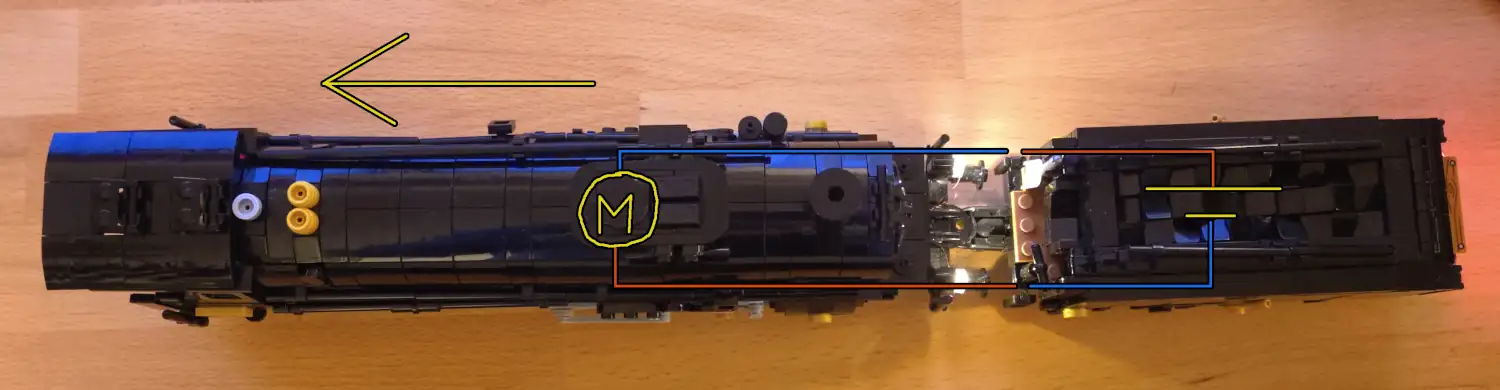
Schematics of a tender engine where the tender and the engine face in the same direction
In the second picture, the front of the engine is coupled to the front of the tender.
Both of them face in the opposite direction.
The battery in the tender powers the motor wires.
On the tender, the brown wire is connected to VCC, the blue wire is connected to GND.
On the engine, the brown wire is connected to GND, the blue wire is connected to VCC.
The motor makes the engine drive backwards compared to the natural direction of the engine, which is the forward as the direction of the tender holding the battery.
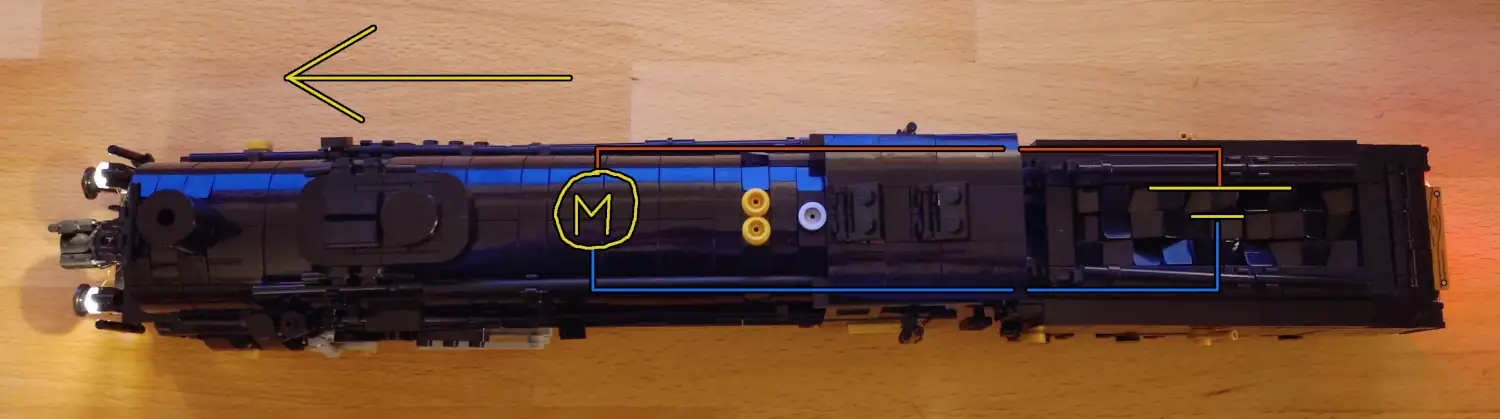
Schematics of a tender engine where the tender and the engine face in the opposite directions
As one can see, the train travels in the same direction both cases.
It's the direction the car holding the receiver (and in this case battery as well) is facing, which is the tender in this case.
This alignment ensures all engines travel in the very same direction.
It also ensures the train traveling in the direction, the remote control is dictating towards the receiver in the tender.
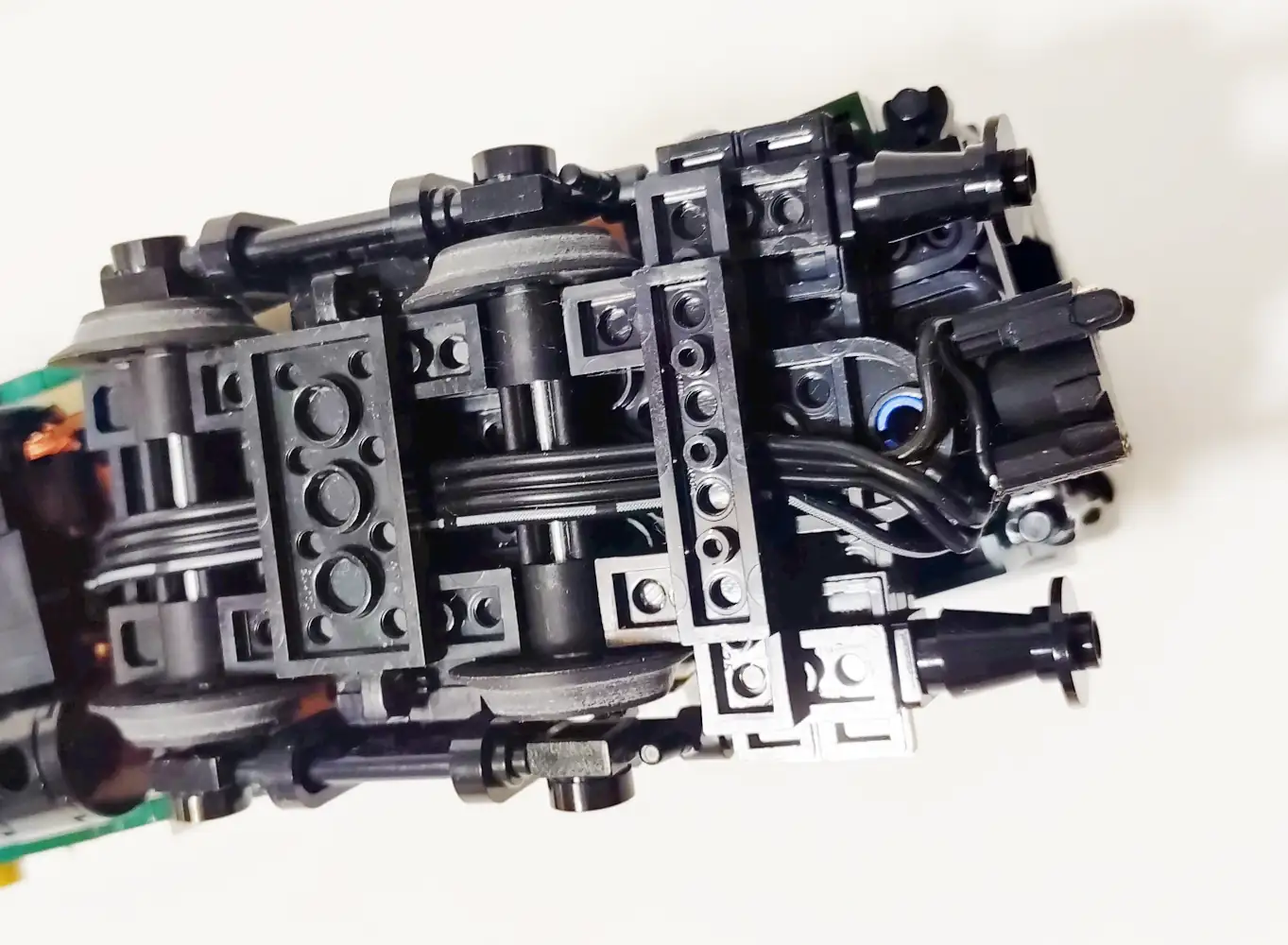
Instead of colourful wires, a flat ribbon cable shall work as well. These are well known in their use in power functions cabling. And they can be used for the couplers as well. Sadly, they don't offer the same level of opportunity to demonstrate the functions of the individual wires, so they don't fit well for demonstration purposes. They do look good though.
Coupler with a flat ribbon cable
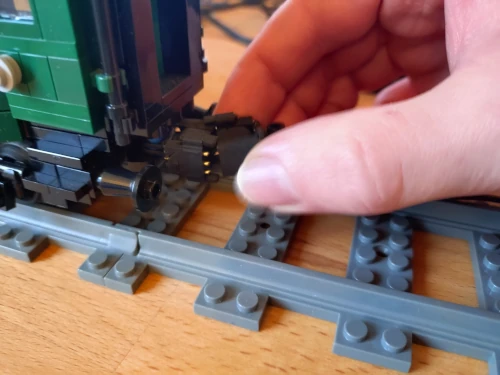
Because one of the goals of the coupling is to be compatible with existing couplings, pogo pins come to mind. Male-female-contacts would collide with the existing couplings. Even whel protected by centering devices, they would have to be placed outside of the space, existing couplers occupy. Which results in a big coupler or the electrical coupler not being able to couple to the center of an existing coupler to the costs of holding force.
After deciding on using pogo-pins, I tried moving the contacts outside away from the center of the coupler while still keeping the coupler as small as possible and within the width of 2 studs. This comes with various benefits.
The magnet inside of the coupler can be bigger.
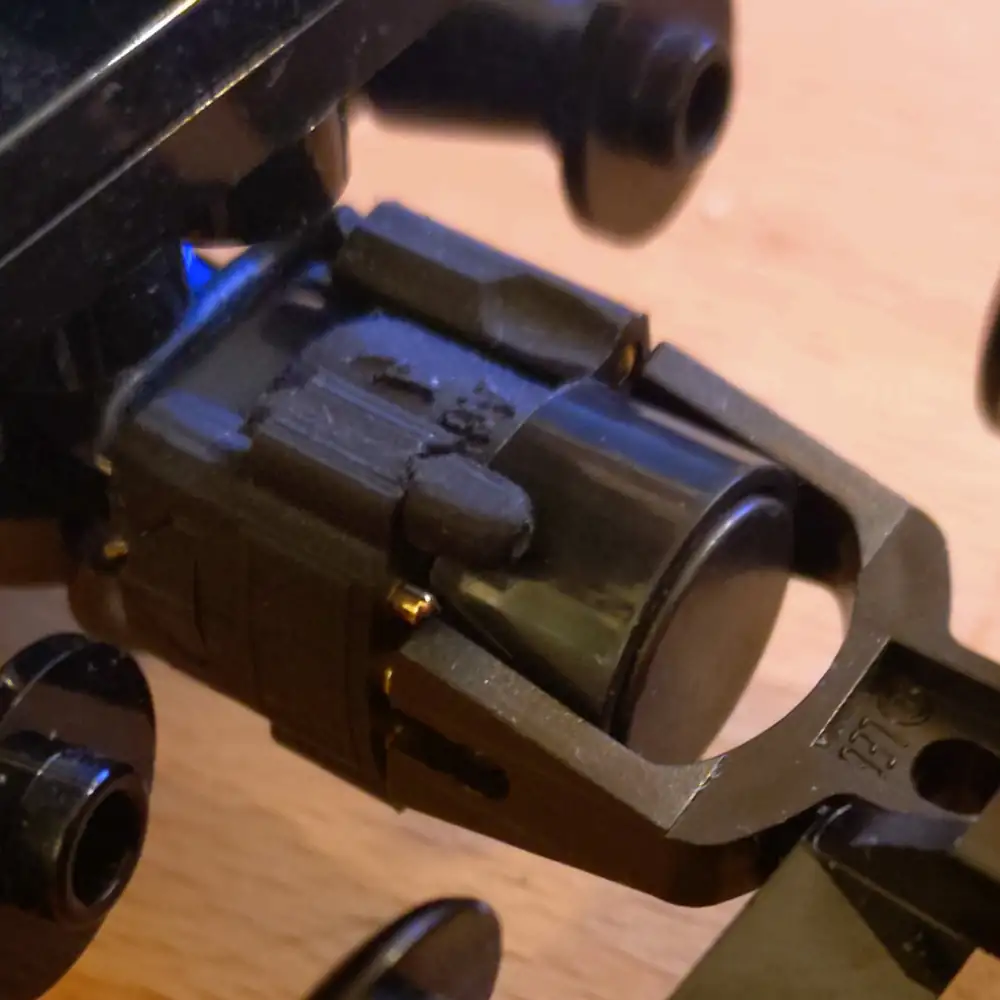
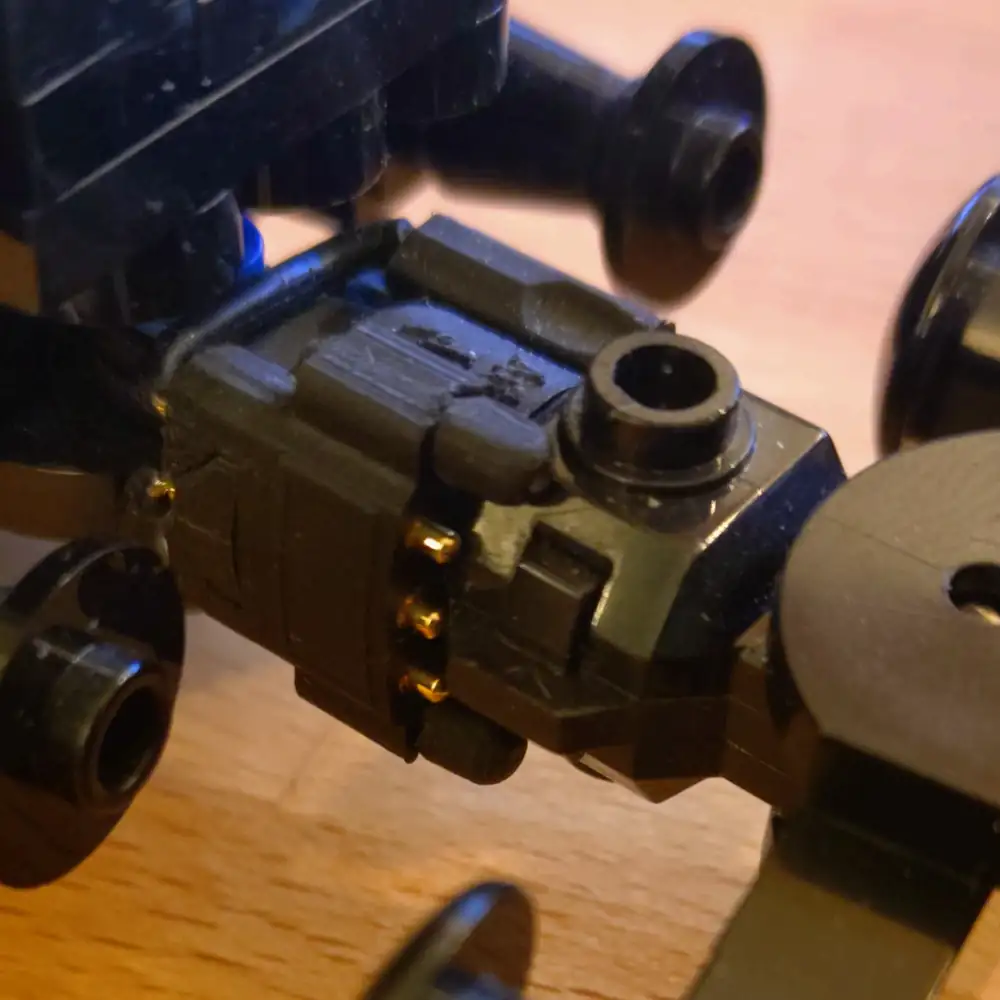
Also when coupled with he old spinning magnet couplers, the contact pins are not touching the magnet. Instead they touch the magnet holder, which has an offset from the outer line of the magnet, resulting in the pogo pins not being fully compressed. Compressing the pogo pins costs force the couplers won't have holding the train. It's a small margin, but it's also without a downside. The almost same things holds true with the newer coupler design with the housed magnet. The edges of the coupler are bevelled, exactly where the pogo pins are applying their force.
Because one of the goals of the coupling is to be compatible with existing couplings, pogo pins must be used.
Male-female-contacts would collide with the existing couplings.
In addition, the centering by the magnets is not precise enough for such small male-female-contacts.

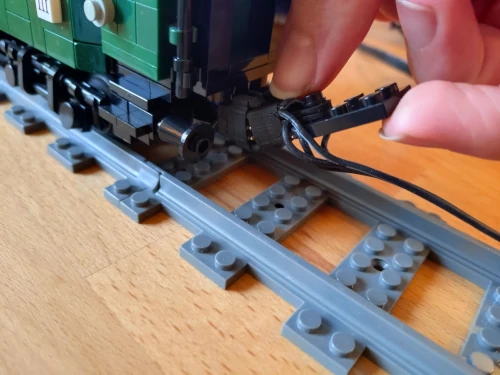
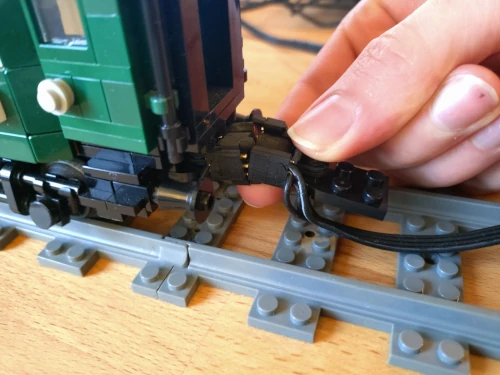
Coupled togehter with known designs
These are one of, if not the mayor update on the design compared to the first version.
The centering devices prevent short circuits but ensure the correct pin placement throughout.
Without the centering devices, the C1/C2 pin row could connect to either the VCC or GND pin row, closing the C1 to C2 circuit without a electrical consumer, and thus overloading the IR receiver / similiar devices.
I've grilled a couple of mould king 4.0 boxes like that. Preventing this issue was the number one goal of the new design.
I've tested the new design for dozens of hours ensuring this will not happen again, and I do feel confident in this issue being solved with the new design.
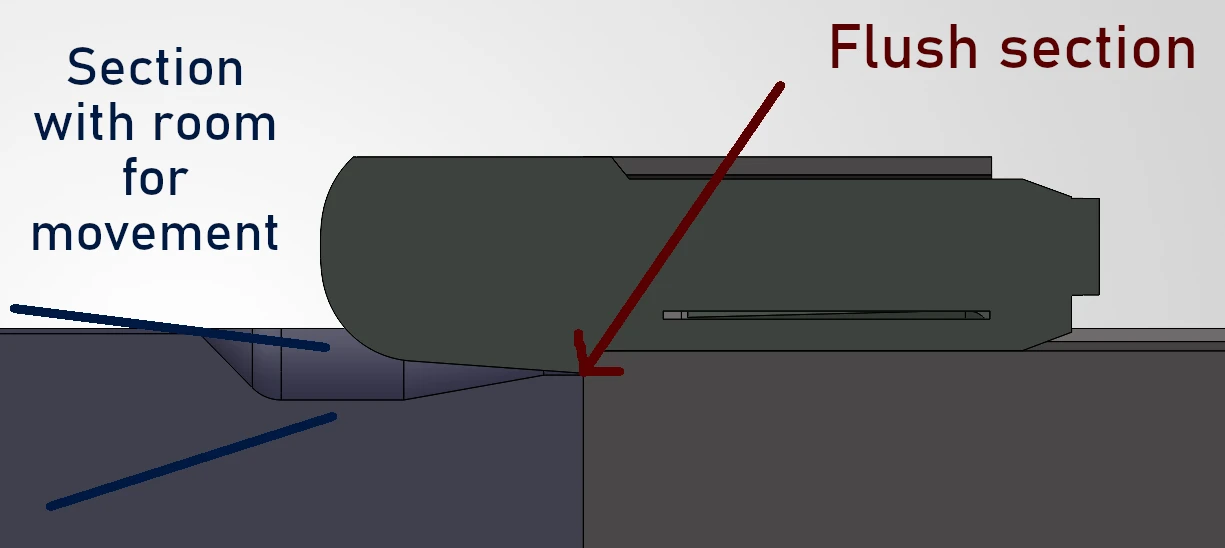
The centering devices allow a certain amount of play between the couplers.
They can pitch and yaw, but are restricted in rolling.
This is important to compensate for non-perfect aligned track as well as transitioning between flat, uphill and downhill track.

Design of the centering devices allowing a certain amount of play

Allowed amount of play in between two couplers
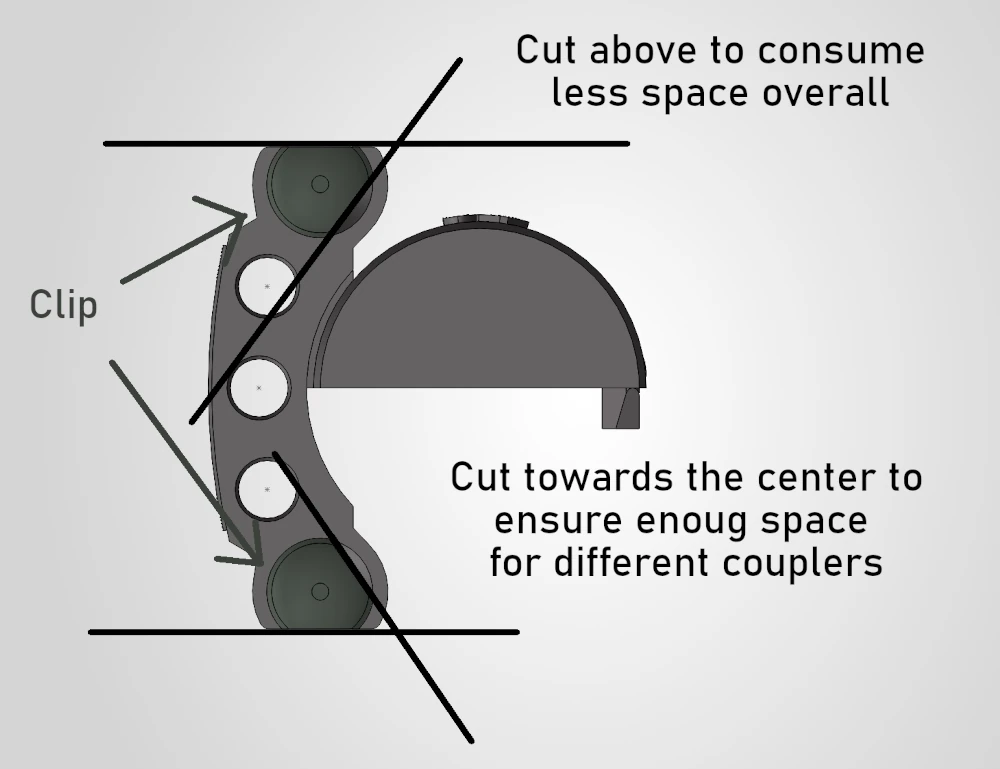
The centering devices are not round, to both allow for a smaller footprint of 16 mm in total heigth as well as coupling together with the known designs.
A small clip holds the centering devices in place.
Geometry of the centering devices seen from the front of the coupler
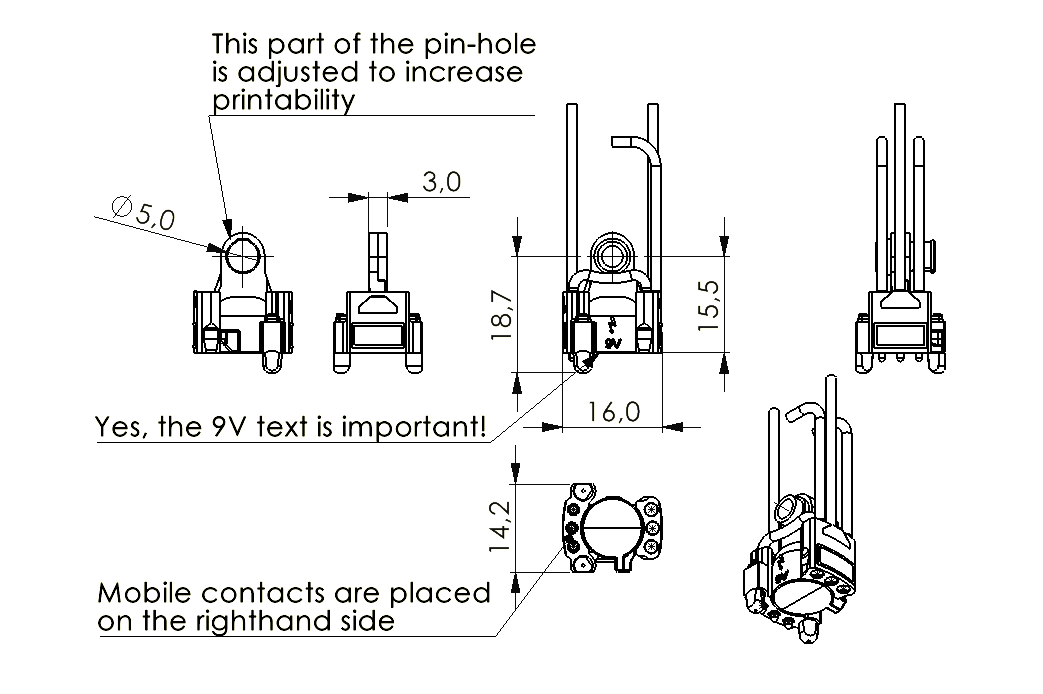
There are mayor improvements on the housing compared to the first version.
- centering devices exist
- instead of glueing in the pogo-pins, retaining clips hold the pogo-pins in place
- the housing can be printed on a FDM printer
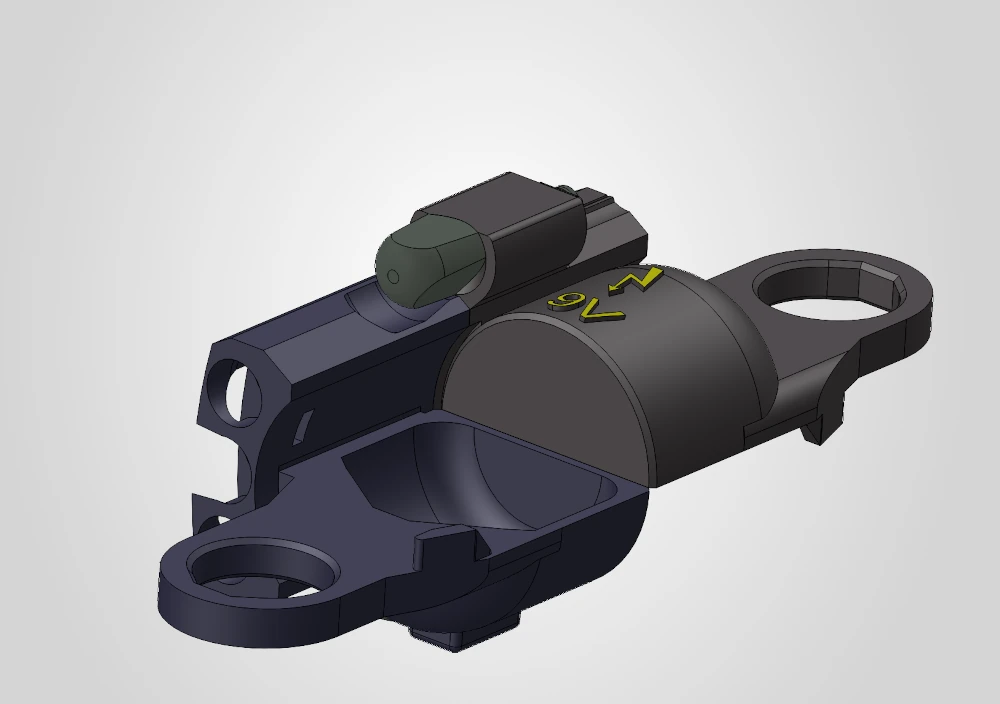
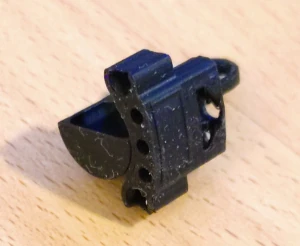
The housing is 2 studs wide (16mm) and is as long as the original magnet couplers.
The heigth of the coupler is a little lower than the heigth of the new original couplers.
Instead of having a pin itself, the coupler uses a pin hole which reduces the precision needed on the print.
Each housing consists of 6 parts in 4 different lots.
There are the upper- and lower side of the housing, one of each. In plus, two identical centering devices as well as two identical retaining clips are needed to complete the assembly.
All of these parts can be printed on a FDM printer.
Recommended nozzle size is 0.2mm.
Drawing of the housing, dimensions in mm
Download the .STEP of the upper side of the housing.
Download the .STEP of the lower side of the housing.
Download the .STEP of the clip.
Download the .STEP of the centering device.
Download the .3mf of the whole coupler.
The "9V" and the lightning symbol can be painted as it is raised.
| What | Picture | Amount per coupler | Comment | How to get it? |
|---|---|---|---|---|
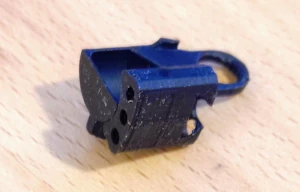
| Upper side of the housing | ![]() |
1 | Can be printed in resin and FDM. Recommended nozzle is 0.2mm. | 3D print it yourself, the download link can be found just above. |
| Lower side of the Housing | ![]() |
1 | Can be printed in resin and FDM. Recommended nozzle is 0.2mm. | 3D print it yourself, the download link can be found just above. |
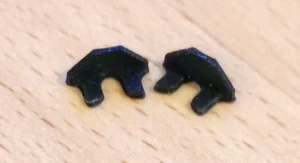
| Clip | ![]() |
2 | Can be printed in resin and FDM. Recommended nozzle is 0.2mm. | 3D print it yourself, the download link can be found just above. |
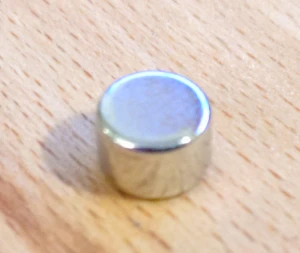
| Magnet 6x4 round | ![]() |
1 | I use neodyn magnets for my couplers. | Sold online on various sites |
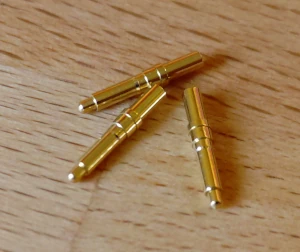
| Pogo Pin Mill-Max 0962-0-15-20-75-14-11-0 | ![]() |
3 | This pogo pin fits in the housing. In case you want to use a different pogo pin, you might need to adjust the housing for it. | Sold online on various sites |
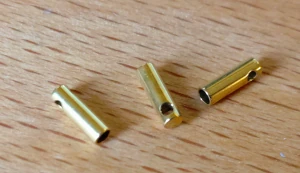
| Steel cord cape with gold flash. Item Nr. 4000927091460 | ![]() |
3 | 1,6mm gold option of "Stainless Steel Clasps Hooks Cords End Caps Cord For Jewelry Making Bracelet Necklace DIY Jewelry Findings" | Found on a website selling directly from china. |
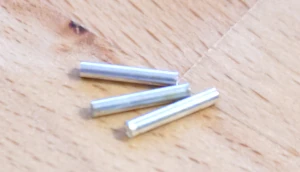
| Bare wire end ferrules, uninsulated, 0.5 mm˛ | ![]() |
3 | Used to crimp the wires on the non-pogo-pin-side together. Can be from just any brand. | Sold online on various sites |
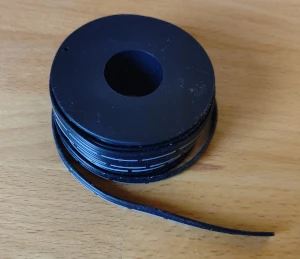
| Wires, around AWG 23, AWG 24 or 0,25mm2, colours red, blue, brown and black or as flat ribbon | ![]() |
you deicde | I recommend flexible silicone wires for this application. You can also use smaller wires, but mind the intended amps you want to transfer here. You can also use different colours of course. | Sold online on various sites |
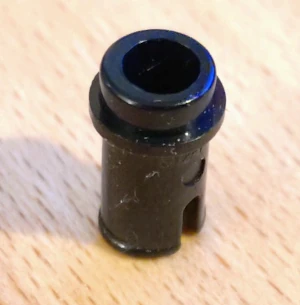
| Technic, Pin 1/2 without Friction Ridges, Item No: 4274 | ![]() |
1 | I use these to mount the coupler to the train. You can use what ever you want to use to mount the coupler. | Your brick collection. In case you don't have one, it's sold online on various sites |
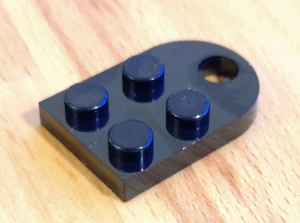
| Plate, Modified 2 x 3 with Hole, Item No: 3176 | ![]() |
not mandatory | I use these to mount the coupler to the train. You can use what ever you want to use to mount the coupler. | Your brick collection. In case you don't have one, it's sold online on various sites |
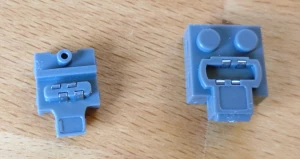
| PF connector | ![]() |
not mandatory | I use these for modularity. You do not need them to build the coupler. | Found on a website selling directly from china. |
| What | Picture | Comment | How to get it? |
|---|---|---|---|
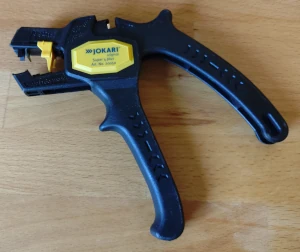
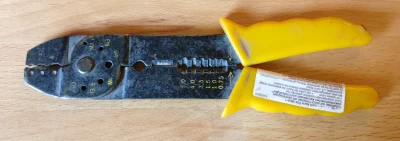
| Wire stripper | ![]() |
I love mine! Can only recommend | Sold online on various sites or your local hardware store |
| Crimp tooling | ![]() |
Either you use the proper DMC, or... you simply just use any plier available. The recommended DMC is linked on the datasheet of the pogo pins | Sold online on various sites or your local hardware store |
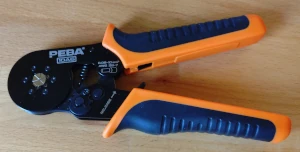
| Crimp tooling | ![]() |
I use this one for the wire end ferrules | Sold online on various sites or your local hardware store |
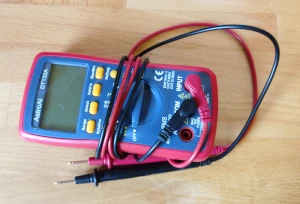
| Multimeter | ![]() |
Always check the insulation as well as connections of the whole cable! This is a safety meassure you shall not mess with. I use a cheap multimeter for this | Sold online on various sites or your local hardware store |
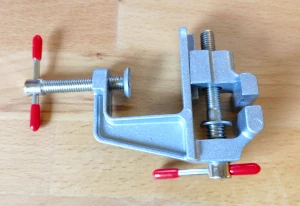
| (small) Vice | ![]() |
I use a vice like this to close the PF connectors | Sold online on various sites or your local hardware store |
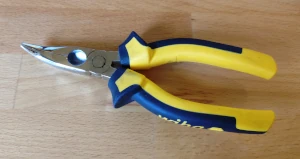
| Plier | ![]() |
A plier can both cut cable as well as pushing some pogo pins into the housing in case the tolerances are against us | Sold online on various sites or your local hardware store |
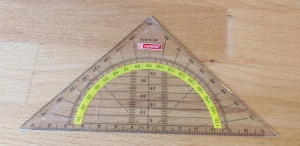
| Ruler | ![]() |
Somehting to meassure distances between 5 to 40 mm with | Sold online on various sites, your supermarket or your local hardware store |
Contact and Copyright:
webmaster@flemmbrav.de
latest change: happened